How AI Deciphered Rosetta Stone Cartouches: A Modern Linguistic Breakthrough
How AI Deciphered Champollion’s Rosetta Stone Cartouches: A Modern Linguistic Breakthrough
The Rosetta Stone is one of history’s most famous archaeological discoveries. Unearthed in Egypt in 1799, the ancient slab carried the same decree in three scripts: Greek, Demotic, and Egyptian hieroglyphs. Its inscriptions eventually enabled Jean-François Champollion to unlock the hieroglyphic writing system in 1822.
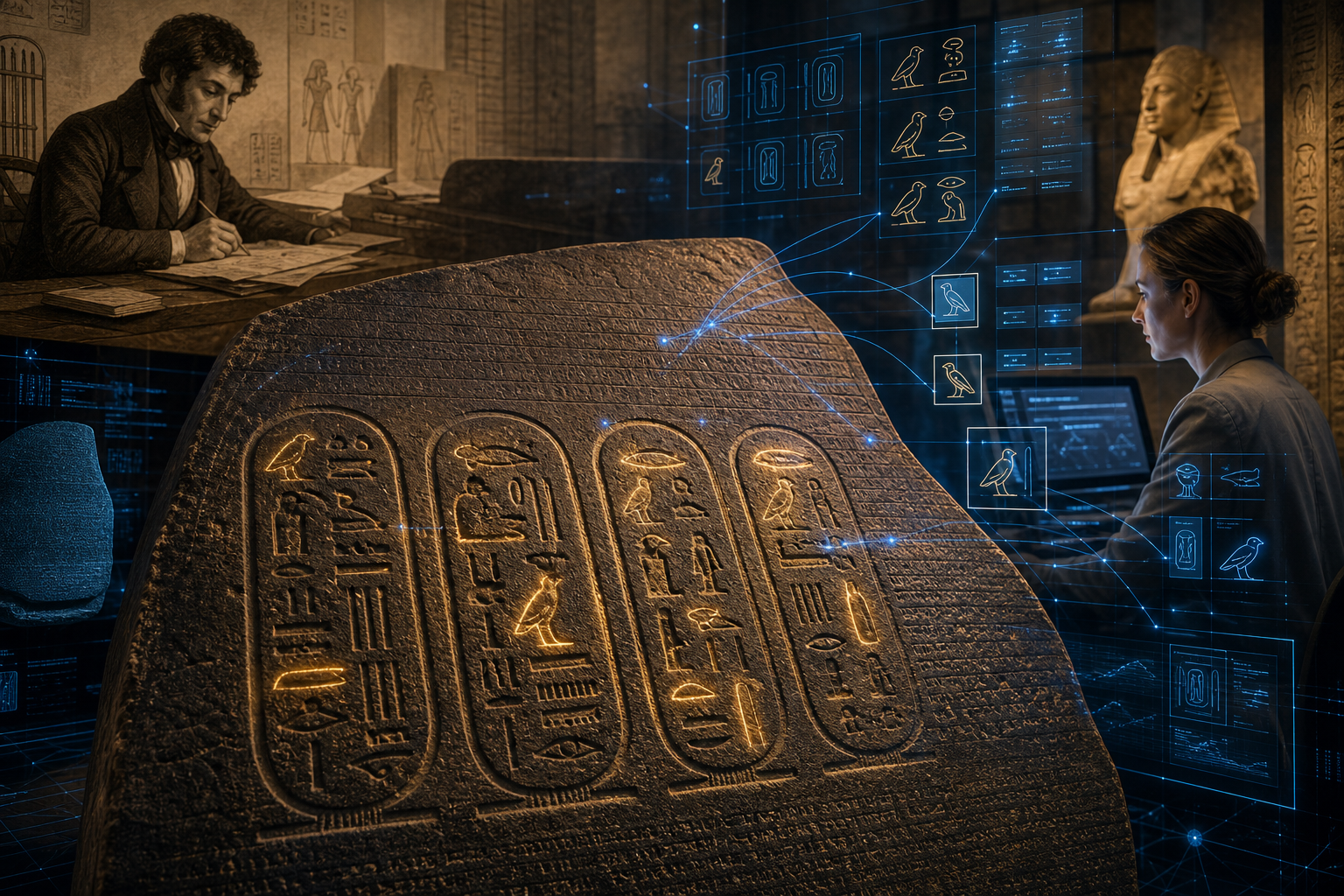
Today, artificial intelligence is adding a new dimension to that achievement. By analyzing cartouches—the oval-shaped frames surrounding royal names—AI systems are helping researchers compare inscriptions, identify recurring symbols, and understand how Champollion reached his breakthrough.
Why the Rosetta Stone Mattered
Before the Rosetta Stone, scholars could recognize Egyptian hieroglyphs but could not reliably read them. Many believed the symbols represented only abstract ideas or religious concepts. The presence of the same decree in Greek, Demotic, and hieroglyphic scripts changed the problem from pure speculation into comparative linguistics.
Greek was already understood, providing a translation key. Researchers could then search the Egyptian versions for names, titles, and repeated phrases that appeared in the Greek text.
The most valuable clues were royal cartouches. Egyptian scribes placed the names of pharaohs inside these distinctive oval frames, making them easier to isolate from surrounding text.
Champollion’s Linguistic Insight
Champollion studied cartouches belonging to rulers such as Ptolemy and Cleopatra. Because these names were known from the Greek inscription, he could compare their likely sounds with the hieroglyphs inside the cartouches.
His crucial insight was that hieroglyphs could function phonetically, representing sounds rather than merely ideas. Some symbols also served as logograms or determinatives, but the phonetic principle made it possible to read names and eventually broader Egyptian texts.
This discovery transformed Egyptology. Hieroglyphs were not simply artistic symbols with symbolic meanings; they formed a complex writing system that combined sound, meaning, and grammatical clues.
How AI Studies the Cartouches
Modern artificial intelligence approaches the problem through pattern recognition and language modeling. Researchers can train computer vision systems on large collections of Egyptian inscriptions, allowing them to detect symbols even when carvings are damaged, faded, or incomplete.
AI-assisted analysis can help with several tasks:
- Symbol identification: Recognizing individual hieroglyphs in photographs or scans.
- Cartouche detection: Locating oval royal-name frames within larger inscriptions.
- Pattern comparison: Matching similar signs across monuments and manuscripts.
- Transliteration support: Connecting signs with proposed sounds in scholarly databases.
- Damage reconstruction: Estimating missing portions based on known textual patterns.
These tools do not replace Egyptologists. Instead, they rapidly perform repetitive comparisons that would take human researchers much longer.
Revisiting Champollion’s Method
AI also makes it possible to reconstruct the reasoning behind Champollion’s work. A computer can compare cartouches across different inscriptions and identify recurring signs in royal names. For example, if a particular symbol appears in both a known form of Ptolemy and another royal name, the system can test whether the sign consistently represents the same sound.
This approach reflects the logic of comparative linguistics:
- Identify a repeated name or phrase.
- Compare its position in parallel texts.
- Isolate recurring symbols.
- Test possible phonetic values.
- Confirm the result against additional inscriptions.
Champollion carried out this process manually, using drawings, notes, and years of careful study. AI can now perform similar comparisons across thousands of records in a fraction of the time.
The Limits of Artificial Intelligence
Despite its power, AI cannot independently “read” ancient Egyptian with perfect accuracy. The technology depends on reliable training data, accurate transcriptions, and expert interpretation. A damaged symbol may have several possible readings, while the meaning of a word can change according to context.
There is also a danger of treating statistical probability as certainty. An AI model may suggest the most likely interpretation, but scholars must still examine grammar, historical context, writing conventions, and parallel evidence.
The strongest results come from collaboration between machines and experts. AI identifies patterns; Egyptologists evaluate their significance.
A New Chapter in Egyptology
The story of Champollion and the Rosetta Stone remains a landmark in the history of decipherment. Artificial intelligence does not diminish his achievement. Instead, it reveals how innovative his methods were and extends them into the digital age.
By combining image recognition, linguistic analysis, and historical scholarship, researchers can study cartouches with unprecedented speed and precision. The result is not a replacement for human discovery but a powerful new tool for understanding the ancient Egyptian world.
The Rosetta Stone opened the door to Egyptian writing two centuries ago. Today, AI is helping scholars explore what lies beyond that door.