Mapping the Spiceways: How Malabar Black Pepper Reached Medieval Europe
Mapping the Spiceways: How Malabar Black Pepper Reached Medieval Europe
Long before supermarkets made pepper a common kitchen staple, black pepper was among the most valuable goods in the medieval world. Known as “black gold,” it traveled thousands of miles from the humid forests of India’s Malabar Coast to the dining tables, markets, and apothecaries of Europe.
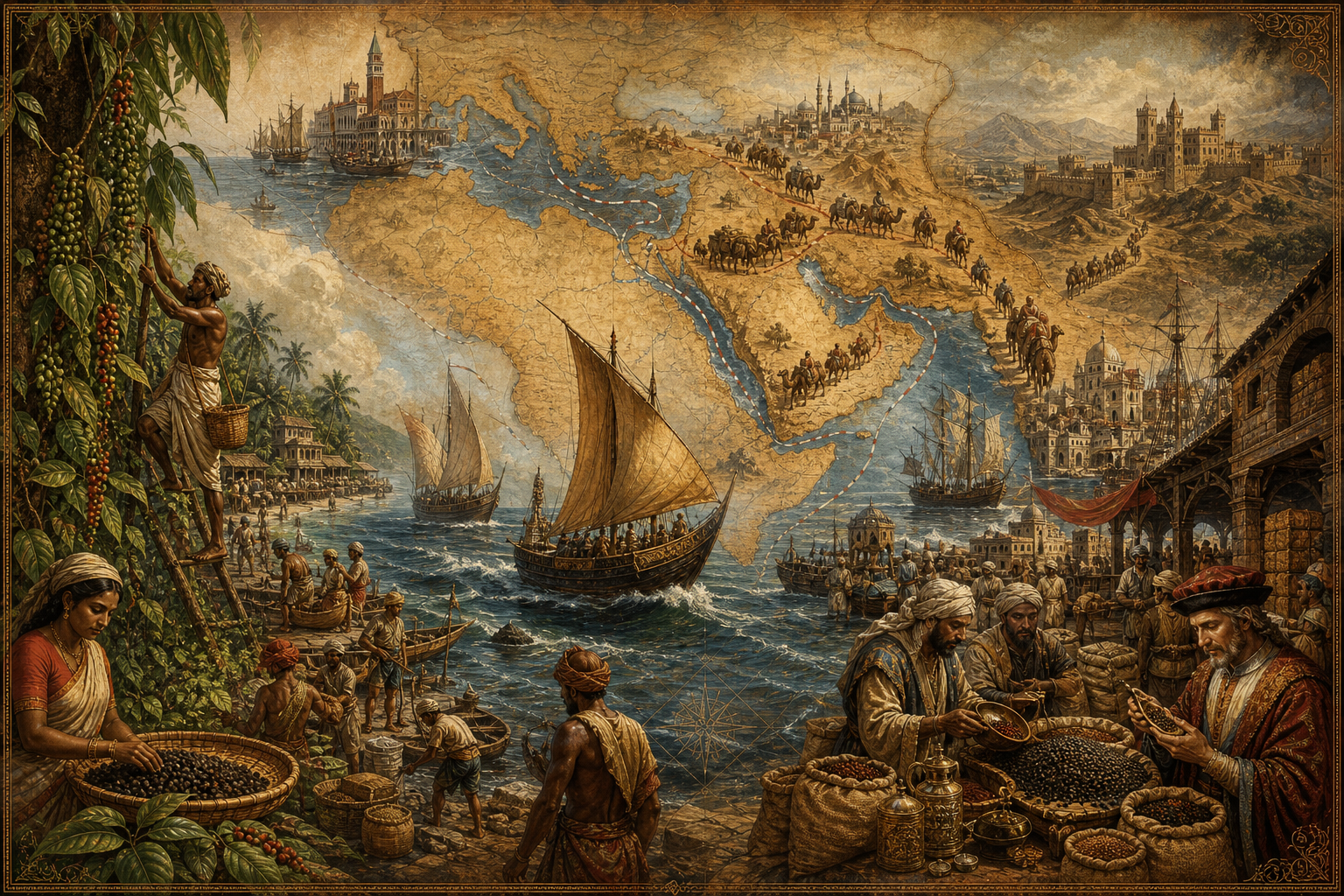
The journey of Malabar black pepper was not a single route but a vast network of sea lanes, desert crossings, river passages, and commercial partnerships. Its story reveals how geography, empire, and maritime skill shaped medieval trade.
The Pepper Vineyards of the Malabar Coast
Malabar, located along the southwestern coast of present-day India, offered ideal conditions for growing pepper. The region’s tropical rainfall, rich soil, and dense forests allowed pepper vines to climb trees and produce clusters of small green berries.
Farmers harvested the berries while they were still green. After drying them in the sun, the berries shriveled and darkened, creating the pungent spice now known as black pepper.
For centuries, local communities cultivated and traded pepper. Ports such as Muziris, Kollam, and later Calicut became important commercial centers, linking inland producers with merchants from across the Indian Ocean.
Monsoon Winds and Indian Ocean Trade
The first great stage of pepper’s journey was shaped by the monsoon. Seasonal winds reversed direction every year, allowing sailors to travel between India, Arabia, and East Africa with remarkable regularity.
Arab and Persian merchants played a central role in this trade. Ships loaded with pepper sailed west from Malabar to ports on the Arabian Peninsula and the Red Sea. These voyages connected Indian producers to powerful commercial cities such as Aden, Jeddah, and Suakin.
Navigation relied on knowledge passed down through generations. Sailors watched the stars, studied currents, and timed departures according to the monsoon. Their expertise made it possible to transport pepper across waters that could be dangerous and unpredictable.
From India to the Red Sea
One major route carried pepper to the Red Sea. From ports such as Aden, merchants moved the spice northward through the sea’s narrow channels toward Egypt.
The Egyptian port of Aydhab served as an important link for a time, though trade routes shifted as political power and local conditions changed. Alexandria eventually became the main Mediterranean gateway for eastern spices.
From there, pepper could reach merchants from Venice, Genoa, and other European trading cities.
Overland Routes Through the Islamic World
Not all pepper traveled by sea. Some shipments moved through overland networks connecting the Indian Ocean with the Middle East and the Mediterranean.
Caravans carried spices from Red Sea ports to the Nile Valley, where they were transported by river or overland to Cairo and Alexandria. Other routes passed through Mesopotamia, Persia, and Syria, linking ports and inland markets.
These journeys involved numerous middlemen. Each stage added costs, risks, and profits. Taxes were collected at borders and city gates, while merchants had to protect their cargo from theft, weather, and political conflict.
Despite these difficulties, pepper remained attractive because its high value made long-distance transport worthwhile.
Venice and the European Spice Market
By the late medieval period, Venetian merchants had become dominant distributors of eastern spices in Europe. Venice’s location at the northern end of the Adriatic Sea gave it access to Mediterranean trade routes and markets north of the Alps.
Venetian merchants purchased pepper and other spices from suppliers in Alexandria and the Levant. They then transported them to warehouses, fairs, and commercial centers throughout Europe.
From Venice, pepper traveled to cities such as Augsburg, Bruges, London, and Paris. Merchants used rivers, roads, and established market routes to distribute the spice across the continent.
Venice’s success depended not only on ships but also on diplomacy. Agreements with rulers, port authorities, and trading communities helped Venetian merchants secure access to valuable cargoes.
Why Medieval Europeans Valued Pepper
Pepper was prized for more than its flavor. Medieval cooks used it to season meat, fish, sauces, soups, and preserved foods. Wealthy households often displayed pepper as a sign of status and sophistication.
It was also used in medicine. Physicians believed that pepper could stimulate digestion, warm the body, and balance certain illnesses according to traditional theories of health.
Because pepper was expensive, it sometimes served as a form of payment. Taxes, rents, and dowries could be calculated partly in spices. In some regions, possessing pepper signaled access to international commerce and elite culture.
A Global Network Before the Modern Age
The path of Malabar black pepper to medieval Europe demonstrates how interconnected the medieval world had already become. Indian farmers, Arab sailors, Egyptian officials, Persian merchants, Venetian traders, and European consumers all participated in the same commercial system.
The spice moved across cultural and political boundaries, carried by people who understood the seas, deserts, markets, and customs along the way. Each shipment represented years of agricultural labor and months of coordinated trade.
By the end of the medieval period, European demand for pepper helped inspire new efforts to reach India by sea. The search for a direct route would eventually transform global history—but the foundations had already been laid by the old spiceways linking Malabar to Europe.