
How Parietal Globularization Created Recursive Grammar in Human Cognition
The Cognitive Leap: How Parietal Globularization Created Recursive Grammar
Human language is more than a system for naming objects or signaling danger. It allows us to describe events inside other events, imagine worlds that do not exist, and connect ideas across time. This ability depends heavily on recursive grammar: the capacity to place one phrase, clause, or thought inside another.
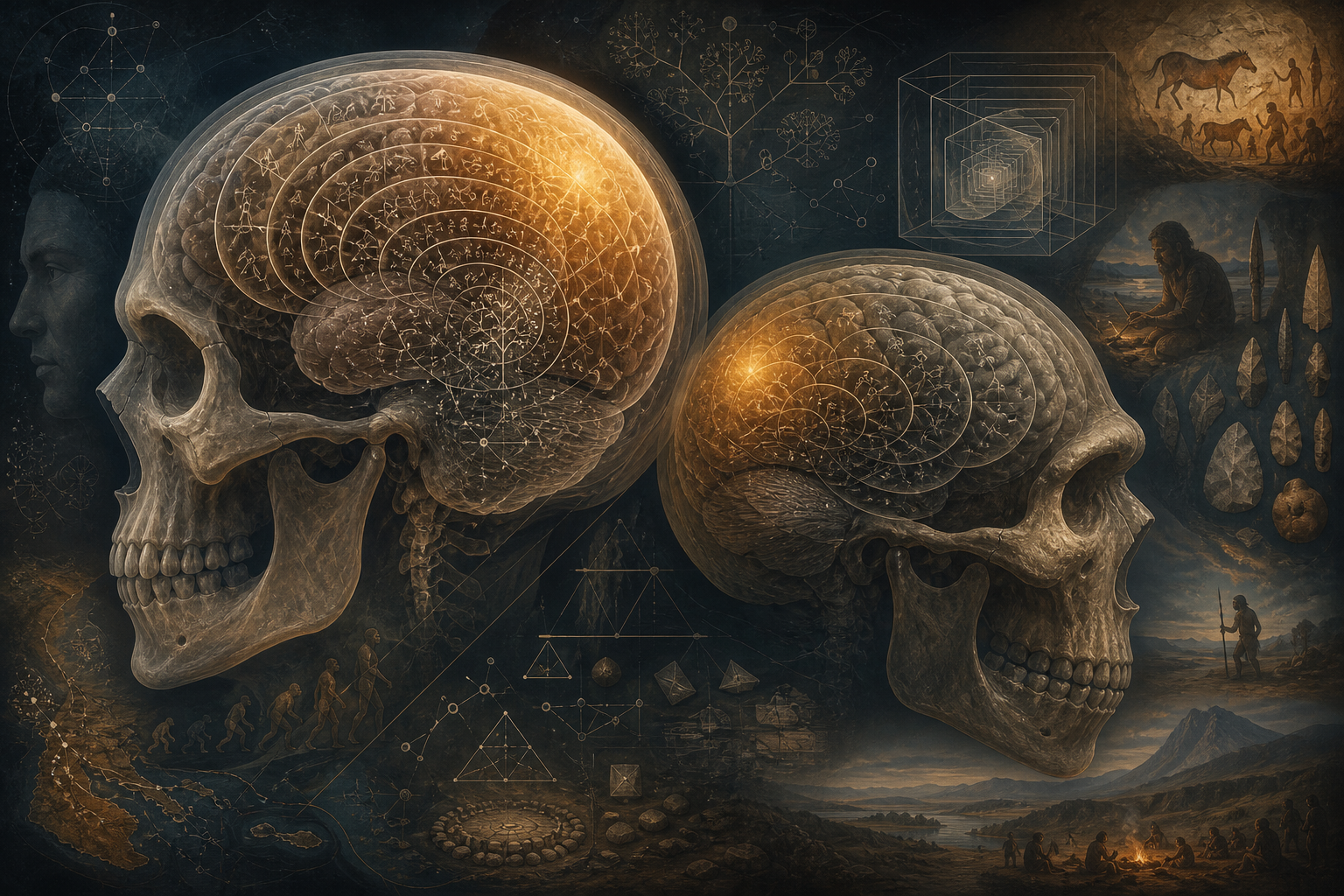
One hypothesis links the emergence of this ability to a major change in the human brain called parietal globularization. During human evolution, the parietal regions became more rounded and expanded relative to those of earlier hominins. This structural shift may have helped create the mental workspace required for complex syntax, hierarchical thought, and symbolic culture.
What Is Parietal Globularization?
The parietal lobes sit near the upper rear portion of the brain. They help integrate information from vision, touch, movement, attention, and spatial reasoning. In humans, these regions are unusually developed and contribute to several abilities that seem central to language, including:
- Sequencing information
- Representing relationships
- Manipulating symbols
- Shifting attention between mental objects
- Combining separate concepts into structured wholes
“Globularization” refers to the more rounded shape of the human braincase, particularly around the parietal areas. Fossil evidence suggests that this transformation occurred relatively recently in human evolution, after the emergence of some earlier human traits but before the full development of modern symbolic behavior.
The change was not simply an increase in brain size. It involved reorganizing the brain’s shape and possibly its internal networks.
Why Grammar Requires Mental Space
A simple signal can connect one sound to one meaning. A complex sentence requires much more. Consider the difference between:
The hunter returned.
and:
The hunter who followed the tracks that crossed the valley returned before sunset.
The second sentence contains multiple layers of organization. The listener must keep track of the hunter, the tracks, the valley, and the timing of events while recognizing how each clause relates to the others.
This is the essence of recursion. A sentence can contain a clause, which can contain another phrase, which can contain additional descriptive information. Understanding such structures requires the brain to maintain several representations at once and bind them into a meaningful hierarchy.
Parietal expansion may have supported this ability by increasing the capacity for mental integration. Rather than processing language as a linear chain of sounds, the brain could represent relationships among multiple elements simultaneously.
From Spatial Mapping to Symbolic Structure
The parietal lobes are strongly associated with spatial cognition. They help us understand where objects are located and how they relate to one another. Some researchers propose that language may have built upon these older systems.
In spatial reasoning, the mind must represent relations such as:
- Above and below
- Inside and outside
- Near and far
- Before and after
- Part and whole
Grammar also depends on relationships. A subject acts on an object. A clause modifies a noun. One event causes or precedes another. The same neural machinery that organizes spatial relations may have been adapted to organize symbolic and grammatical relations.
Under this view, recursive grammar did not appear as an isolated invention. It emerged from a broader capacity to construct nested models of reality.
The Link to Tool Use and Planning
Parietal globularization may also have supported advanced toolmaking and planning. Constructing a complex tool requires holding a goal in mind, imagining intermediate steps, and coordinating parts into a functional sequence.
Recursive language demands a similar process. Speakers begin with a central idea, add a subordinate idea, and then connect further details without losing the original structure. Both activities involve hierarchical planning.
This does not mean that grammar evolved solely for toolmaking. Instead, language, technology, and symbolic thought may have benefited from a shared cognitive foundation: the ability to organize nested relationships and manipulate representations internally.
Evidence and Uncertainty
The relationship between brain shape and grammar remains a hypothesis rather than a settled fact. Fossils can reveal changes in cranial form, but they cannot directly preserve syntax or subjective experience. Nor can brain anatomy alone explain when humans began speaking in fully recursive sentences.
Language likely emerged through the interaction of several factors, including vocal control, memory, social learning, symbolic communication, and cultural evolution. Parietal globularization may have provided an important neurological platform, but it was probably one part of a larger transformation.
A New Way to Understand Human Language
The significance of parietal globularization lies in what it may represent: a shift toward a brain capable of combining information across levels. Once humans could maintain nested representations, they could do more than describe immediate surroundings. They could tell stories, formulate plans, teach invisible rules, and imagine possible futures.
Recursive grammar may therefore be understood as the linguistic expression of a deeper cognitive leap. The rounded human brain was not merely larger; it may have been better organized for building layered models of the world. That capacity helped turn communication into language—and language into one of the most powerful tools of human thought.