How Generative AI Reconstructs Extinct Phonology in Ancient Scripts
Decoding Ancient Scripts: How Generative AI Reconstructs Extinct Phonology
Ancient scripts preserve the traces of civilizations that disappeared centuries or even millennia ago. Yet written symbols rarely reveal everything about a language. They may record words without vowels, use inconsistent spelling systems, or represent sounds that have no modern equivalent. This makes the reconstruction of extinct phonology—the sound system of a vanished language—one of historical linguistics’ most challenging tasks.
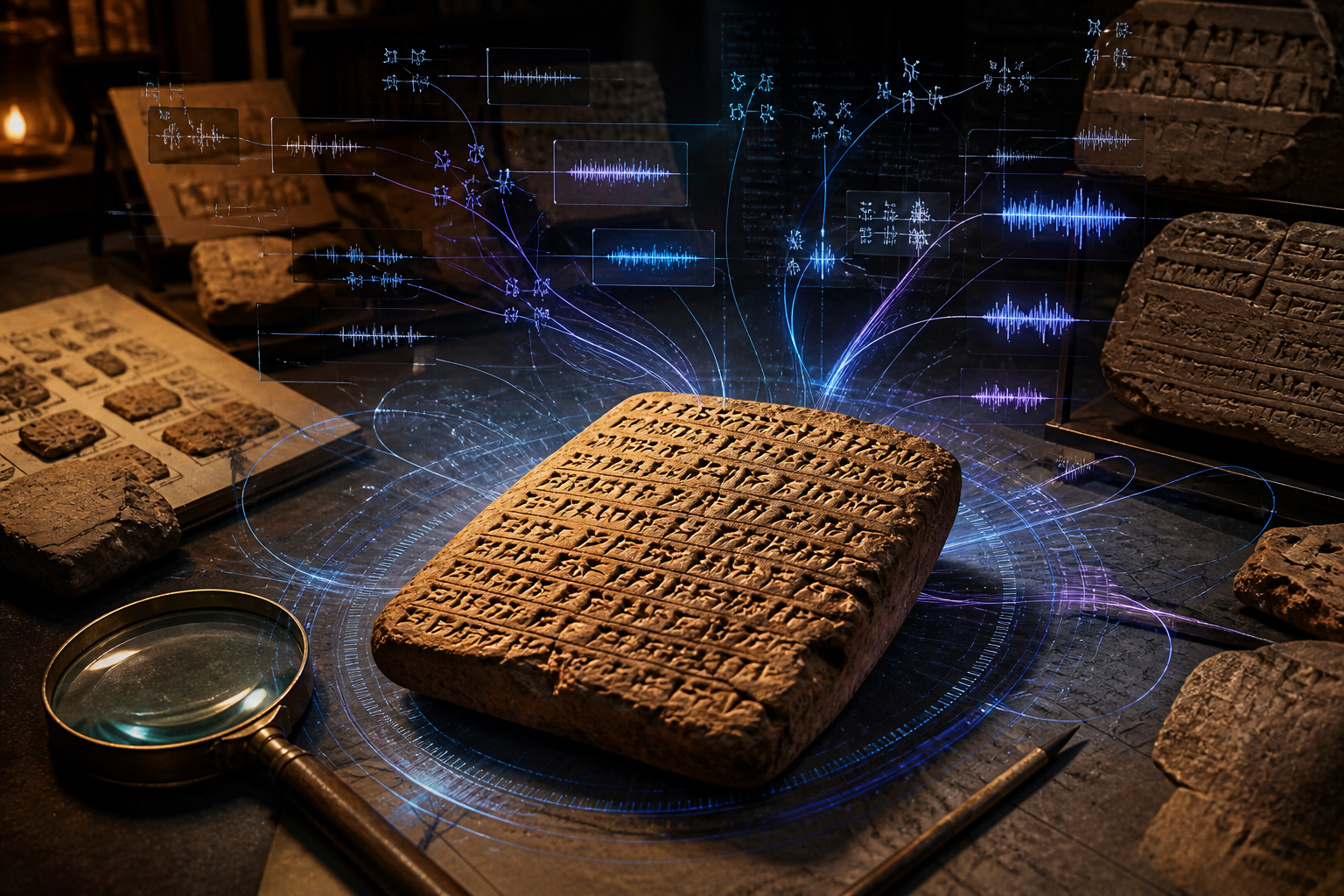
Today, generative artificial intelligence is adding a new tool to that effort. By analyzing patterns across inscriptions, related languages, and historical sound changes, AI models can propose plausible pronunciations for scripts that scholars have struggled to interpret.
What Is Extinct Phonology?
Phonology refers to the way a language organizes sounds. It includes consonants, vowels, syllable structures, stress patterns, and rules governing how sounds change in different contexts.
When a language dies, its phonology often disappears with its speakers. Written records may provide clues, but ancient writing systems frequently create obstacles:
- Some scripts represent only consonants.
- A single symbol may have several possible sounds.
- Spelling conventions may vary across regions and periods.
- Scribes may have copied unfamiliar words inaccurately.
- Pronunciation can change while writing remains traditional.
For example, a script might preserve the same character for a sound that gradually shifted from one consonant to another. Without recordings or living speakers, researchers must reconstruct the original pronunciation indirectly.
How Generative AI Helps
Generative AI works by identifying relationships in large datasets and producing informed predictions. In historical linguistics, the relevant data may include:
- Digitized inscriptions
- Bilingual or multilingual texts
- Translations into better-understood languages
- Names borrowed by neighboring civilizations
- Descendant languages
- Comparative pronunciation data
- Archaeological information about time and location
Instead of treating an inscription as an isolated puzzle, an AI system can examine it as part of a broader network. It may recognize that a sequence of symbols resembles a word in a related language, or that a recurring spelling appears in contexts associated with a particular grammatical form.
The system can then generate several phonological hypotheses, assigning confidence levels based on the available evidence.
Pattern Recognition Across Related Languages
One of the strongest methods for reconstructing ancient sounds is comparison. Languages descended from a common ancestor often preserve related words, even when their pronunciations have changed.
Suppose several ancient and modern languages contain similar terms for “water.” If the words share certain consonants but differ in their vowels, generative AI can model the likely historical transformations. It may identify regular sound correspondences and use them to estimate how an undocumented ancestor was pronounced.
This approach does not simply search for identical words. It analyzes recurring transformations, such as:
- A consonant becoming softer between vowels
- A long vowel shortening in unstressed syllables
- A consonant disappearing at the end of a word
- Two previously distinct sounds merging over time
The more examples available, the more reliable the reconstruction becomes.
Reconstructing Missing Vowels
Many ancient writing systems leave vowels unwritten or represent them inconsistently. This creates a major challenge because vowels can distinguish entirely different words.
Generative AI can estimate missing vowels by examining grammatical and contextual patterns. If a particular consonant sequence appears in sentences with several related forms, the model may infer that the variations reflect case, tense, number, or derivation.
For instance, a sequence written as K-T-B might correspond to several words built from the same root. By comparing its surrounding words and known grammatical structures, AI can propose likely vocalizations and determine whether the language used predictable vowel patterns.
These predictions remain hypotheses, but they can help scholars prioritize which interpretations deserve closer examination.
Context Matters More Than Symbols Alone
A major advantage of generative AI is its ability to study context. A symbol’s meaning and pronunciation may depend on its position in a word, neighboring signs, or the type of document in which it appears.
A royal inscription, a trade record, and a religious hymn may use the same vocabulary differently. AI models can classify these contexts and detect subtle patterns that are difficult to observe manually across thousands of texts.
They can also compare spelling variants from different locations and periods. This allows researchers to distinguish regional accents, scribal traditions, and genuine language change.
The Limits of AI Reconstruction
Generative AI does not recover ancient pronunciation with certainty. It produces models based on incomplete evidence, and those models can reflect errors or assumptions in their training data.
Several risks require caution:
- The system may favor modern language patterns.
- Poorly transcribed inscriptions can introduce false relationships.
- Similar-looking symbols may not represent related sounds.
- Rare words may be interpreted through misleading analogies.
- A statistically likely pronunciation may not be historically correct.
For this reason, AI should support—not replace—philological expertise. Linguists, historians, and archaeologists must evaluate whether a proposed reconstruction fits the script, grammar, chronology, and cultural context.
A New Era of Linguistic Discovery
The combination of traditional scholarship and generative AI is opening new possibilities for ancient language research. Models can process vast collections of inscriptions, identify hidden regularities, and generate competing reconstructions for experts to test.
Decoding Ancient Scripts: How Generative AI Reconstructs Extinct Phonology is ultimately not about allowing machines to “hear” the distant past. It is about using computation to organize evidence and reveal patterns that might otherwise remain invisible.
As datasets improve and researchers develop more transparent methods, AI may help restore fragments of pronunciation once thought permanently lost. The result will not be a perfect recording of vanished speech, but a more detailed and evidence-based understanding of how ancient people expressed themselves.