
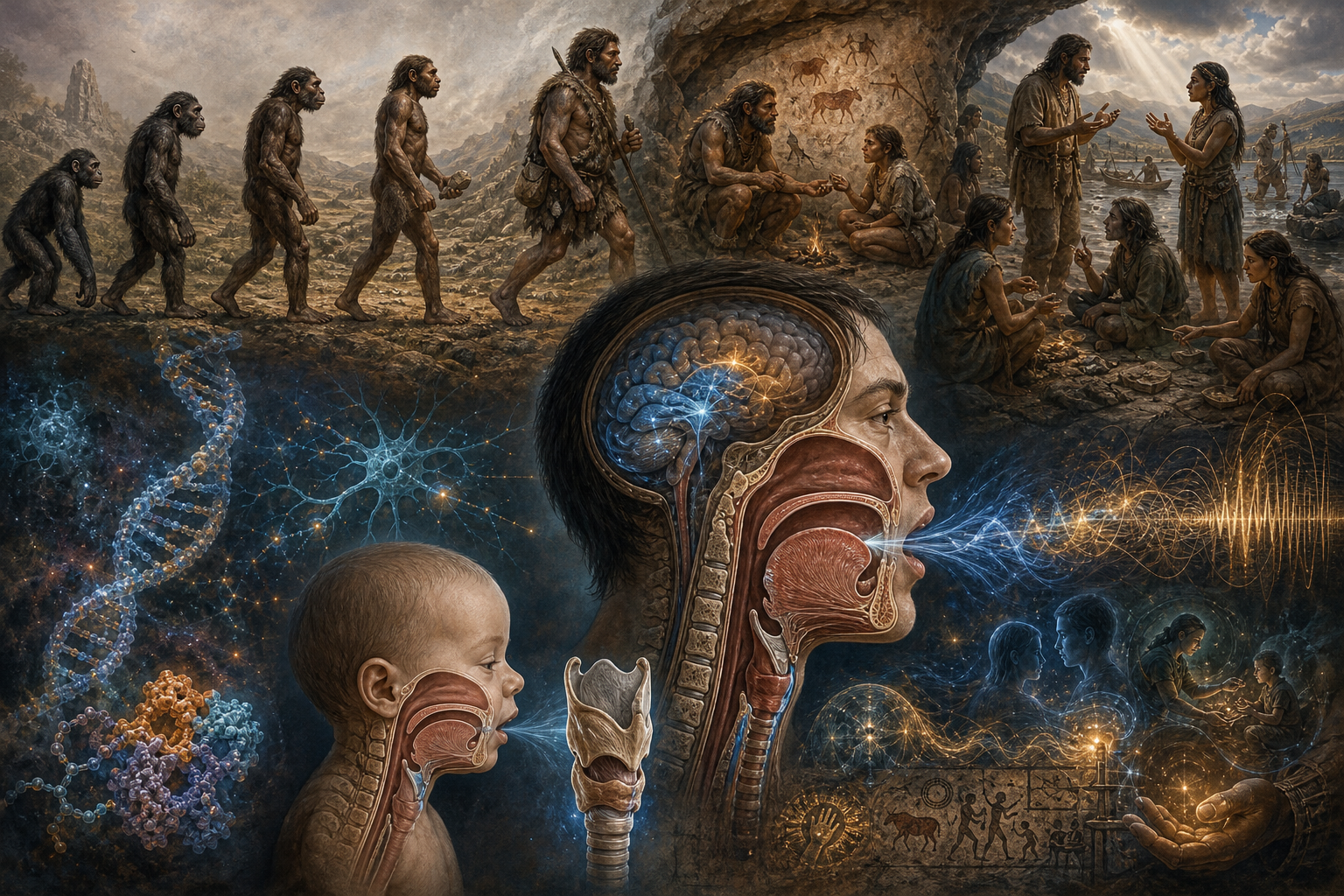
FOXP2 and the Descended Larynx: Evolutionary Timeline of Human Language
FOXP2 and the Descended Larynx: The Evolutionary Timeline of Human Language
Human language is one of evolution’s most remarkable achievements. It depends on the brain’s ability to process symbols, the body’s capacity to produce controlled sounds, and the social skills needed to share meaning. Two subjects often appear at the center of this story: the FOXP2 gene and the descended larynx.
Both offer important clues about how speech evolved. However, neither provides a single, definitive explanation for the origins of language. Instead, they represent separate pieces of a much larger evolutionary puzzle.
What Is FOXP2?
FOXP2 is a gene involved in regulating other genes, particularly those associated with brain development, learning, and motor control. It became widely known after researchers studied the KE family, a British family in which several members had difficulty coordinating the movements required for fluent speech.
Some affected individuals could understand language but struggled to produce precise sequences of sounds. This suggested that FOXP2 played a role in the neural control of speech—not that it was a “language gene” in a simple or exclusive sense.
FOXP2 is also found in many animals, including birds, bats, and mice. This matters because the gene did not suddenly appear in humans. Rather, evolutionary changes in its regulation and interactions with other biological systems may have contributed to distinctly human abilities.
FOXP2 and Human Evolution
Modern humans and Neanderthals appear to have shared similar versions of the FOXP2 protein. This finding suggests that some relevant genetic changes may have occurred before the two lineages separated, more than 500,000 years ago.
That does not prove that Neanderthals spoke like modern humans. Language requires many traits beyond FOXP2, including memory, social communication, vocal learning, breath control, and sophisticated brain networks.
The most reasonable conclusion is that FOXP2 helped support the motor and learning systems necessary for speech, while later evolutionary changes shaped how those systems were used.
The Descended Larynx
The larynx, or voice box, sits higher in the throat of human infants than in most adult humans. During childhood, it descends, creating a longer vocal tract. This arrangement allows humans to produce a wider range of vowel sounds.
A descended larynx has often been described as a uniquely human adaptation for speech. Yet the anatomy is more complicated than that claim suggests. Some animals, including certain deer and other mammals, also have relatively low larynges. In addition, humans can produce speech before the larynx completes its descent.
The descended larynx may therefore have expanded the range and clarity of speech sounds rather than created language by itself.
Why Vocal Tract Shape Matters
Speech depends on modifying air from the lungs as it passes through the vocal tract. The tongue, lips, jaw, palate, and larynx work together to create different sounds. A longer vocal tract can make certain vowel distinctions easier to produce and perceive.
However, this anatomical advantage also carries a cost. A lower larynx increases the risk of food entering the airway, which can lead to choking. The fact that humans retain this structure suggests that its communication benefits may have outweighed its dangers—or that the anatomy arose as a side effect of other changes in head, neck, and facial structure.
A Possible Evolutionary Timeline
The evolution of language likely unfolded gradually rather than through one sudden breakthrough.
- Early primates: Ancestors developed increasingly complex social communication and vocal control.
- Early hominins: Changes in posture, breathing, facial anatomy, and brain organization may have supported more deliberate vocal signals.
- The last common ancestor of humans and Neanderthals: Important aspects of speech-related genetics, including an ancestral form of FOXP2, were already present.
- Neanderthals and early modern humans: Both groups probably possessed advanced vocal and cognitive abilities, although the extent and structure of their languages remain uncertain.
- Modern Homo sapiens: Cultural learning, symbolic thought, cooperation, and increasingly complex social networks allowed language to become highly flexible and powerful.
This timeline should be viewed as a framework, not a fixed sequence. Language emerged through the interaction of biology and culture over hundreds of thousands of years.
Beyond Genes and Anatomy
FOXP2 and the descended larynx are important because they show that language has both neurological and physical foundations. Yet language cannot be reduced to a gene, an organ, or a particular throat shape.
Human communication also depends on:
- Large, interconnected brain networks
- Long childhoods that support intensive learning
- Shared attention and social cooperation
- Memory and imitation
- Symbolic thinking
- Cultural transmission across generations
The evolutionary history of language is therefore best understood as a gradual accumulation of abilities. FOXP2 may have improved the brain’s capacity to learn and control vocal sequences, while the descended larynx may have broadened the sound system available to speakers. Together with cognition and culture, these traits helped create the uniquely open-ended communication system humans use today.