
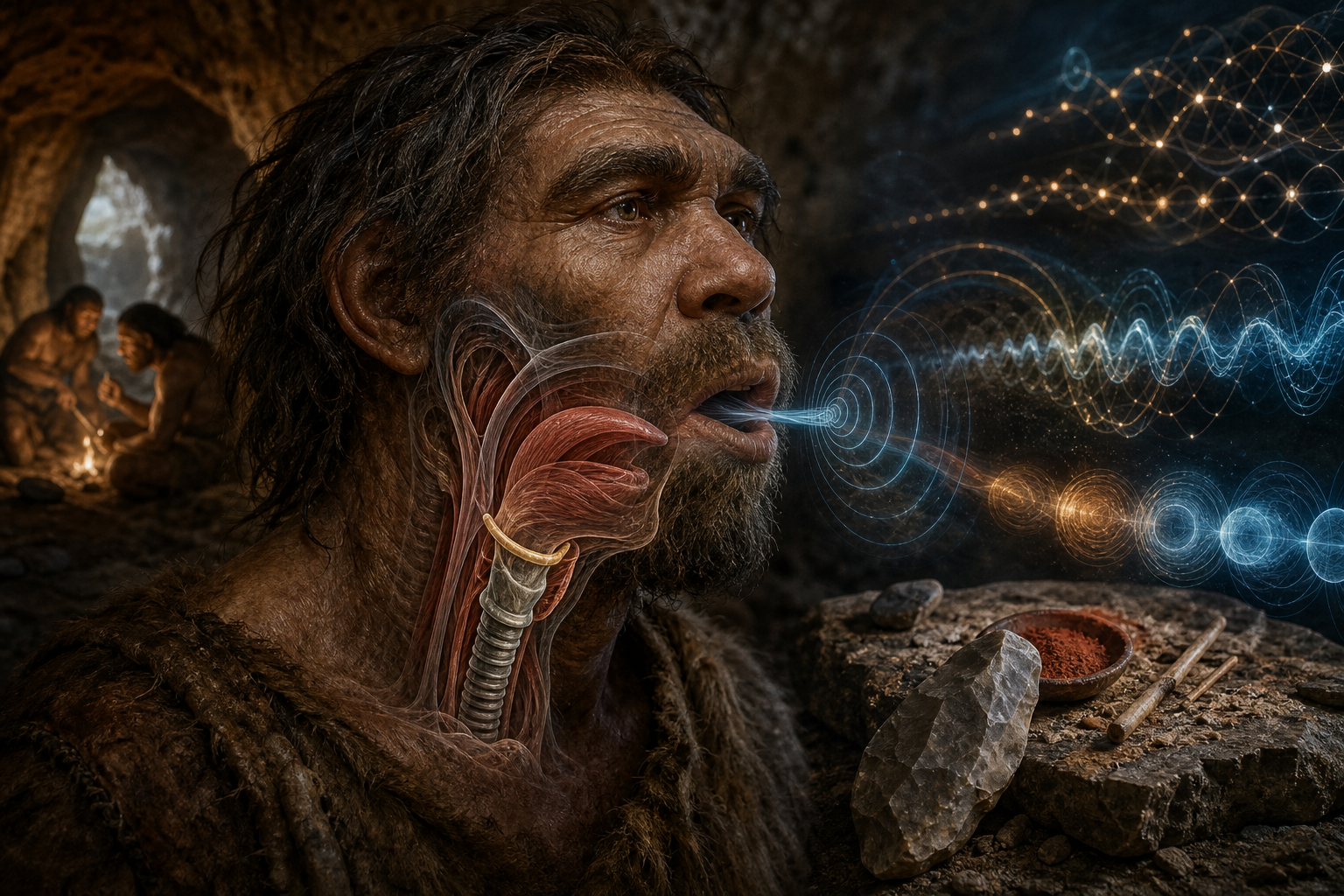
Neanderthal Hyoid Bone and the Biomechanics of Human Speech and Syntax
The Biomechanics of Speech: How the Neanderthal Hyoid Bone Reshaped Human Syntax
For decades, debates about Neanderthal language focused on anatomy. Could these ancient humans produce the sounds required for speech? The discovery and analysis of Neanderthal hyoid bones helped shift that discussion. Their fragile, horseshoe-shaped throat bones resemble those of modern humans, suggesting that Neanderthals possessed a vocal system capable of sophisticated communication.
Yet the importance of the hyoid extends beyond pronunciation. The biomechanics of speech may also help explain how vocal control supported the development of increasingly complex syntax.
What Is the Hyoid Bone?
The hyoid is a small, U-shaped bone located in the upper throat. Unlike most bones, it does not directly connect to another bone. Instead, it is suspended by muscles and ligaments, linking the tongue, larynx, jaw, and upper airway.
This unusual position makes the hyoid central to several functions:
- Controlling tongue movement
- Supporting the larynx
- Shaping the vocal tract
- Coordinating swallowing and breathing
- Modifying speech sounds
The hyoid acts as part of a flexible mechanical system. When muscles move the tongue and larynx, the shape of the vocal tract changes. Those changes influence resonance, pitch, and articulation.
What Neanderthal Hyoids Reveal
A well-preserved Neanderthal hyoid discovered at the Kebara site in Israel has a shape and structure remarkably similar to the modern human version. Later research, including biomechanical modeling and studies of its internal architecture, indicated that the bone was loaded in ways comparable to a human hyoid during speech-related activity.
This does not prove that Neanderthals spoke exactly as modern humans do. Speech depends on much more than one bone. It requires precise coordination among the brain, lungs, vocal folds, tongue, lips, jaw, and hearing system.
Still, the evidence challenges the older image of Neanderthals as limited communicators. Their anatomy appears compatible with controlled vocal production, while other findings—such as symbolic objects, pigments, and complex tools—suggest advanced cognitive and social abilities.
From Vocal Control to Syntax
The biomechanics of speech matter because syntax depends on timing. A speaker must coordinate a sequence of sounds, pauses, stress patterns, and changes in pitch. Even a simple sentence requires the nervous system to organize multiple movements in the correct order.
The hyoid and connected muscles help make this rapid coordination possible. By adjusting the position of the tongue and larynx, a speaker can produce distinct consonants and vowels. A larger sound inventory gives a communication system more building blocks for meaning.
Syntax then combines those building blocks into structured relationships. Word order, grammatical markers, and rhythm allow speakers to distinguish between an actor and an object, a question and a statement, or a current event and a remembered one.
The hyoid did not create syntax by itself. Rather, it formed part of the physical platform that made increasingly precise vocal communication possible.
Why Anatomy Alone Is Not Enough
It is tempting to treat the Neanderthal hyoid as direct evidence of language. However, anatomy cannot reveal the exact complexity of an extinct species’ grammar. A vocal tract capable of speech does not automatically produce language.
Syntax also depends on:
- Neural organization — Brain networks must plan and interpret structured messages.
- Social learning — Young individuals need opportunities to acquire shared vocal conventions.
- Memory — Speakers must retain words, patterns, and relationships.
- Cultural transmission — Communication systems become more powerful when passed between generations.
- Symbolic thought — Language connects sounds with concepts that may be absent from the immediate environment.
The Neanderthal hyoid therefore represents one piece of a larger puzzle. It supports the possibility of articulate speech, but archaeology and neuroscience must be considered alongside anatomy.
A New View of Neanderthal Communication
The study of Neanderthal speech has moved away from a simple question: “Could they talk?” A more productive question is how their bodies, brains, and social lives worked together to support communication.
Their hyoid anatomy suggests that Neanderthals had the mechanical capacity for controlled vocalization. Their tools and cultural behaviors imply planning and shared knowledge. Taken together, these clues make it increasingly difficult to portray them as silent or linguistically primitive.
The biomechanics of speech may not reveal the precise grammar Neanderthals used, but it helps establish the physical foundation on which syntax can develop. In that sense, the hyoid bone offers a small yet powerful window into the evolution of human language—linking the movements of muscles and bones to the emergence of structured thought.