How Mongol Cavalry Rations Transformed Eurasian Culinary Civilizations
How Mongol Cavalry Rations Transformed Eurasian Culinary Civilizations
The Mongol Empire is often remembered for speed, military organization, and vast territorial expansion. Yet its influence reached beyond battlefields and political borders. The practical food systems that sustained Mongol cavalry helped reshape culinary traditions across Eurasia.
At the heart of this transformation was a simple principle: food had to be portable, durable, nutritious, and easy to prepare. These requirements encouraged techniques that traveled with armies, merchants, migrants, and administrators from the steppes of Central Asia to China, Persia, Eastern Europe, and the Middle East.
The Steppe Diet and the Needs of Cavalry
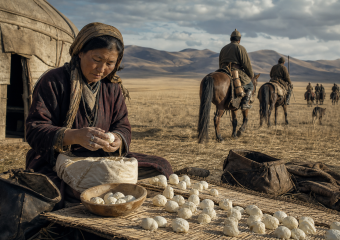
Mongol cavalrymen spent long periods traveling through regions where crops were scarce or seasonal. Their diet therefore depended heavily on livestock. Meat, milk, cheese, yogurt, and fermented dairy products supplied calories and protein without requiring permanent farmland.
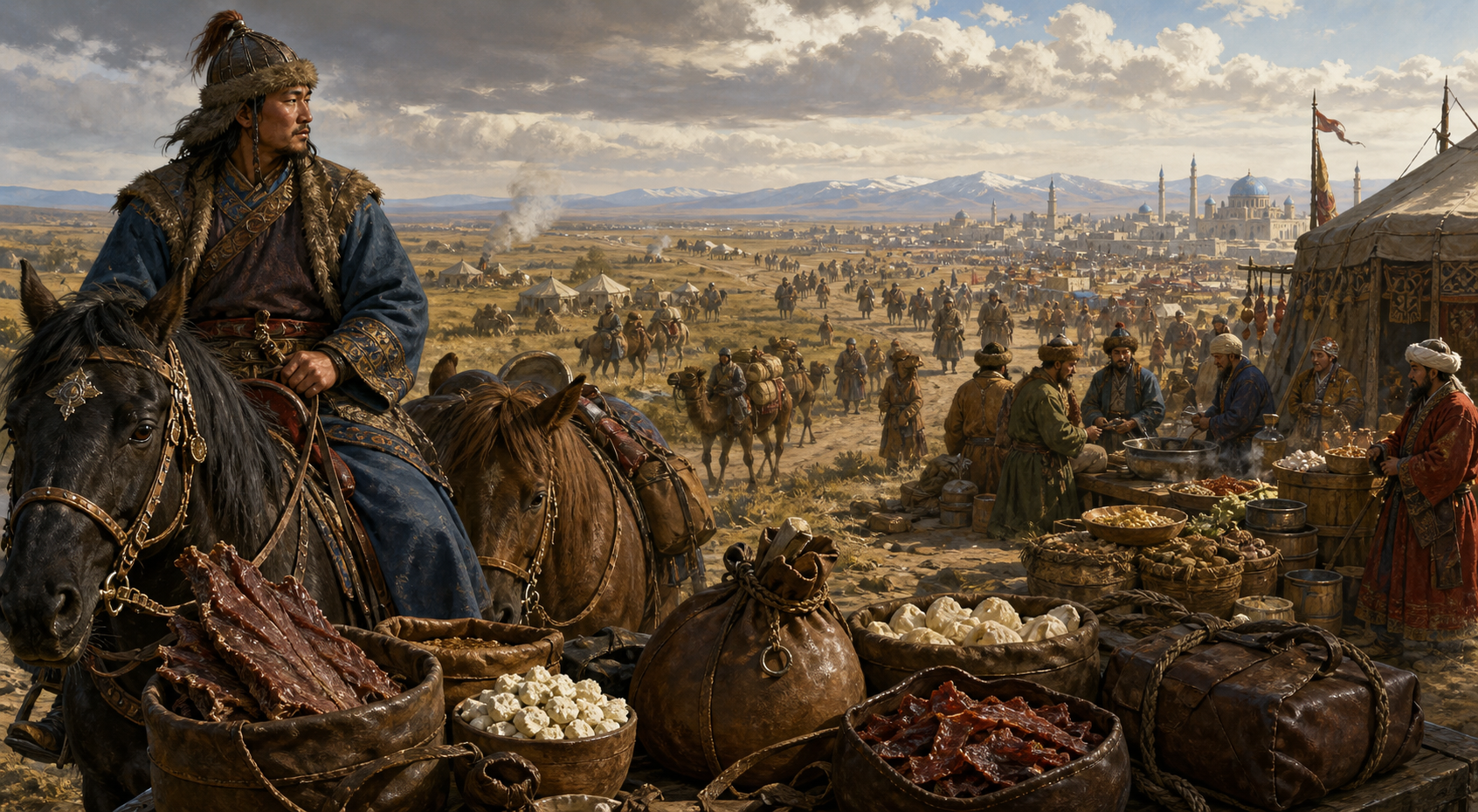
Dried meat was especially valuable. Thin strips could be preserved through drying and carried for weeks. When needed, the meat could be softened in liquid or added to soups and stews. This approach reduced waste and created a reliable food reserve for long campaigns.
Mongols also used fermented mare’s milk, known as airag, as a significant beverage. Fermentation improved storage life and produced a mildly alcoholic drink that carried nutritional value. Other dairy products, including dried curds, were compact and resistant to spoilage.
These foods were not luxurious, but they were perfectly suited to a mobile society. A rider could carry essential provisions without slowing the horse or relying on fixed supply stations.
Portable Food as a Cultural Exchange
Mongol armies moved across an enormous geographic area, bringing cooks, herders, merchants, and local populations into sustained contact. Their rations interacted with the food traditions of conquered and allied communities.
In northern China, Mongol rule connected pastoral foodways with established agricultural cuisines. Dairy products, wheat-based foods, and meat preparations circulated more widely through military and administrative networks. Although Chinese cooking did not become purely pastoral, Mongol-era mobility encouraged new combinations of ingredients and techniques.
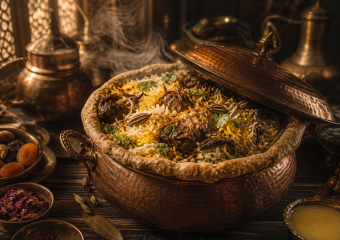
In Persia and Central Asia, Mongol rule intensified exchanges between nomadic and urban culinary cultures. Grilled meats, pilafs, dumplings, and broth-based dishes developed through overlapping traditions rather than a single source. The movement of cooks and ingredients helped popularize rich meat dishes while also encouraging practical methods of preservation.
Meat Preservation and the Evolution of Dried Foods
One of the most lasting influences of Mongol military logistics was the broader circulation of preserved meat techniques. Dried meat could be ground into powder, mixed with fat, or stored in sealed containers. Such methods were useful not only to soldiers but also to travelers, traders, and rural communities.
Across Eurasia, related preservation practices appeared in different forms:
- Air-dried strips of beef, mutton, or horse meat
- Salted and smoked meats
- Dried curds and concentrated dairy products
- Meat-filled dumplings designed for storage and transport
- Broths made from preserved ingredients
These foods reflected a shared logistical challenge: how to maintain nourishment during travel, winter, warfare, or trade. Local ingredients shaped the final dishes, but the underlying emphasis on portability was widely transferable.
Dumplings, Noodles, and Mobile Cuisine
The movement of Mongol forces may also have helped spread or accelerate the exchange of dumpling traditions across Eurasia. Filled dough foods were practical because they combined carbohydrates and meat in a compact form. They could be boiled, steamed, or cooked in broth.
Related dishes emerged across a broad region, including Central Asian manti, Chinese jiaozi, Persian dumplings, and Eastern European varieties such as pelmeni. These foods cannot be attributed solely to Mongol influence; many had earlier local roots. However, the empire’s transportation networks created opportunities for culinary ideas to travel farther and more quickly.
Noodles and hand-pulled dough also moved through interconnected trade routes. In some regions, wheat-based foods were adapted to suit pastoral tastes, while in others, meat fillings and rich broths became central features of established cuisines.
Urban Markets and Imperial Supply Networks
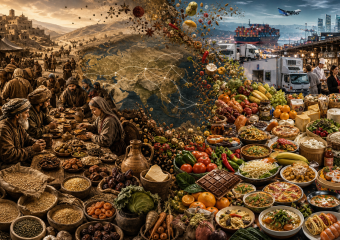
The Mongol Empire did more than move food across landscapes. It also connected cities. Improved security along major routes allowed merchants to transport livestock, grains, spices, dried fruits, and dairy products over greater distances.
Urban markets benefited from this flow. Nomadic communities gained access to grains and vegetables, while settled populations encountered new meat-preservation methods and dairy products. Imperial centers became meeting places where pastoral and agricultural cuisines blended.
This exchange helped create culinary traditions that were neither entirely nomadic nor entirely urban. They reflected the movement of people and resources across political boundaries.
A Legacy of Adaptation
Mongol cavalry rations transformed Eurasian food culture not because they introduced one universal cuisine, but because they promoted adaptable methods. Drying, fermenting, salting, compact packaging, and one-pot cooking all suited a world shaped by movement.
The result was a culinary legacy visible in preserved meats, fermented dairy, filled doughs, hearty broths, and travel-friendly foods. Mongol military logistics turned necessity into innovation, while the empire’s vast networks allowed those innovations to mingle with local traditions.
In this way, the story of Mongol cavalry rations is also a story of cultural exchange. Food designed for riders on the steppe became part of the wider culinary history of Eurasia.